
Most organizations believe that improving financial decision-making starts with more reporting—more dashboards, more metrics, more visibility.
In practice, that assumption often leads to the opposite outcome.
I’ve seen organizations invest heavily in reporting infrastructure only to find that decisions become slower, not faster. Teams spend more time debating the numbers than acting on them. Leadership meetings become focused on reconciling data instead of discussing strategy.
At two different companies, which I inherited, I experienced this situation. Reporting had evolved into a highly complex environment with multiple data sources, heavy reliance on Excel, and different interpretations of the same information. There was no clear, consistent source of truth.
The issue wasn’t a lack of data. It was a lack of trust in the data.
When teams don’t trust the numbers, they hesitate. They validate. They make up their own truth/interpretation. They question. And in doing so, they lose momentum.
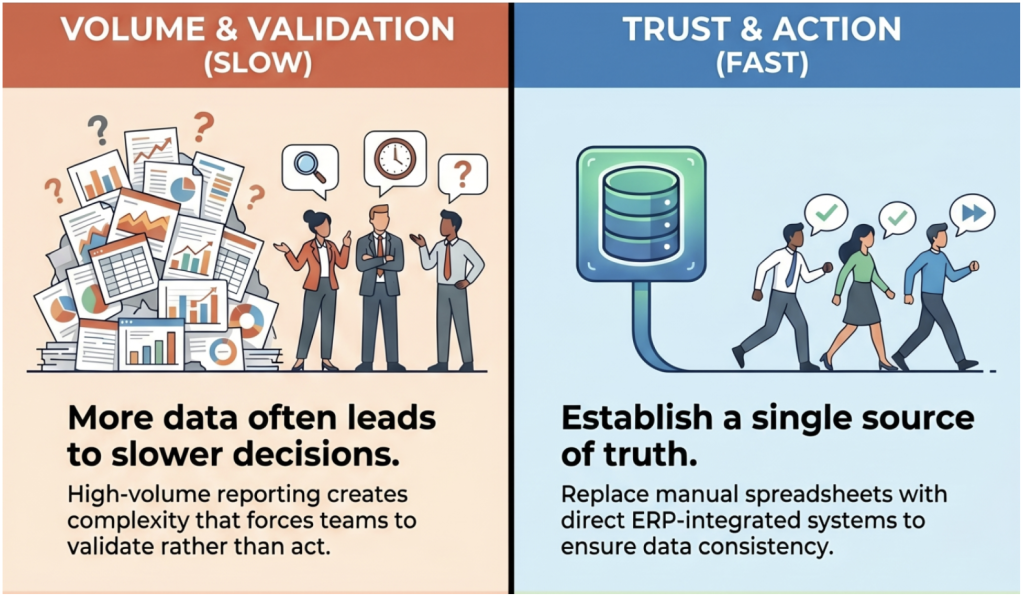
The turning point came when we simplified—not by reducing insight, but by strengthening the foundation behind it. We implemented a system directly tied to our multiple ERPs, creating a single source of truth for financial reporting.
The impact was immediate.
Conversations shifted from “Are these numbers correct?” to “What do these numbers mean?” and “What should we do next?”
That’s the real goal of financial reporting.
What to evaluate in your organization
If reporting feels heavy—or decision-making feels slower than it should—start here:
- Do you have a true single source of truth? Or are multiple versions of data being created and interpreted across teams?
- How much time is spent validating numbers vs. acting on them? If it’s more than you’d expect, your system may be the issue—not your team.
- Are you relying heavily on spreadsheets for core reporting? At a certain level of complexity, Excel introduces more risk than value.
For many organizations, the next step is evaluating financial planning and reporting platforms that integrate directly with their ERP systems. Tools like Vena, Adaptive Insights, or similar platforms can significantly reduce manual work and improve data consistency.
The right solution will depend on the size and complexity of your business—but the principle is the same:
Build your reporting environment around trust, not volume.
The real advantage isn’t more visibility. It’s the ability to act on what you see—quickly and with confidence.